Civilization of the Middle Ages by Norman F. Cantor
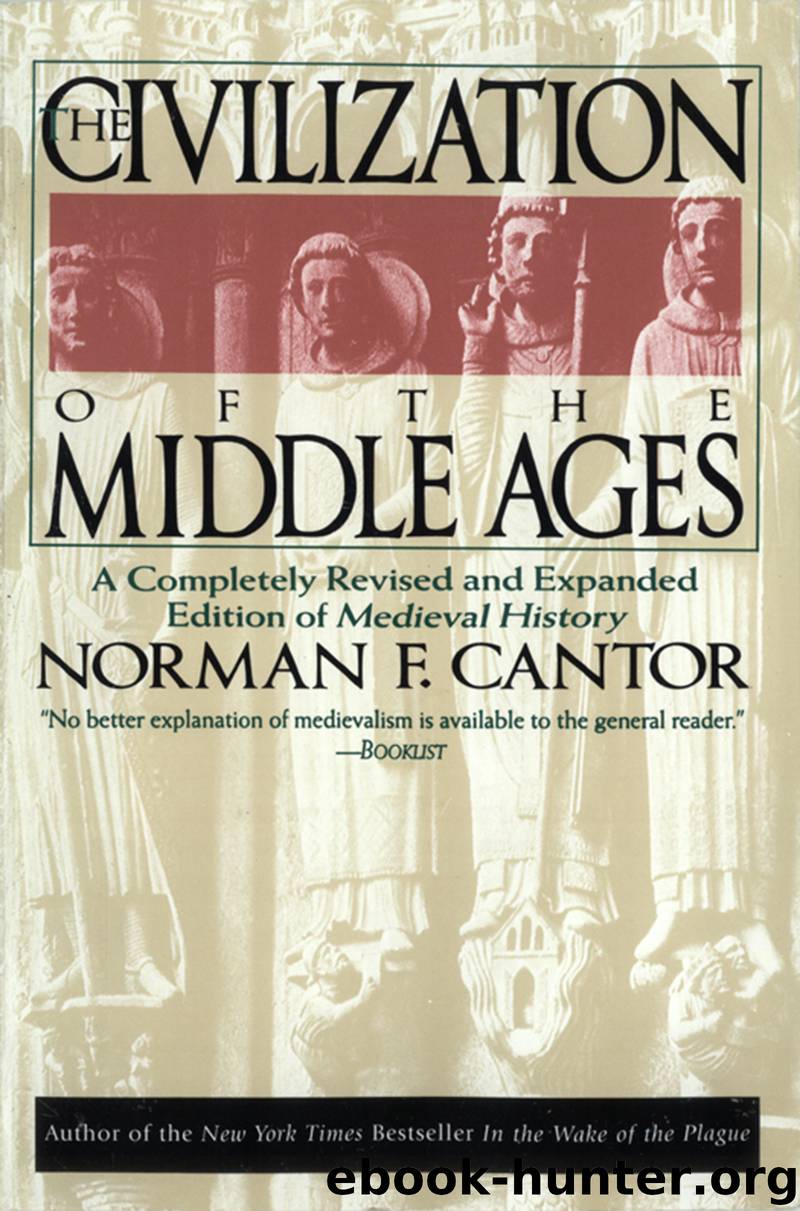
Author:Norman F. Cantor
Language: eng
Format: epub
Published: 2018-10-09T16:00:00+00:00
codification. The results were not encouraging, for even Henry’s scholars were unable to synthesize a comprehensive system out of the welter of Germanic, feudal, and ecclesiastical traditions.
The social need for legal reform and codification, and the enormity of the task, made the beginnings of the study of the Justinian code in northern Italy a momentous event in the history of European government and law. It accounts for both the dedicated zeal with which the northern Italian scholars pursued their study of the civil law and the rapid spread of this Roman law revival north of the Alps. At the beginning of the twelfth century the work of legal scholars was considered to be as socially useful and as much in the interest of the state or the church as the discoveries of the atomic scientists are held to be socially valuable in the twentieth century.
Historians of medieval law are uncertain as to the precise way in which the Justinian code was discovered in northern Italy and its study begun. It has been suggested that the legal studies on behalf of papal authority that were commissioned by Gregory VII led to the accidental discovery in some Italian library of a long-forgotten copy of the Corpus Juris Civilis. On the other hand, it is obvious that the merchants of the northern Italian cities, where the study of Roman law was centered, could have imported a copy of the Justinian code directly from Constantinople. It is of course possible that there was more than one source for the civil law text that scholars in the northern Italian cities first began to study intensively in the 1070s. It is not important how they came by the text; it was not hard to come by, and it had been ignored in western Europe for five centuries because it was irrelevant to the circumstances of early medieval society. What is significant is the great social value that these pioneering legal scholars of the late eleventh century attributed to the Justinian code and that impelled them to begin its intensive study. The codification of the legal system of an advanced civilization into a summary that was written, systematic, comprehensive, and rational suited ideally the legal needs of western Europe at that time. The strong governments toward which European political development was moving were supported by the absolutist doctrine of the Justinian code. In addition, the commercial leaders of the Italian cities were attracted by the law code of an urbanized society that dealt with areas of life unknown to the rural primitivism that lay behind the Germanic customs. The fact that the Justinian code was a summary of the law of the great Roman emperors enhanced its attraction for certain groups, particularly scholars who were conditioned by a strong sense of the classical heritage and enthusiasts for the Holy Roman Empire. But the intensive study of the
Download
This site does not store any files on its server. We only index and link to content provided by other sites. Please contact the content providers to delete copyright contents if any and email us, we'll remove relevant links or contents immediately.
| Africa | Americas |
| Arctic & Antarctica | Asia |
| Australia & Oceania | Europe |
| Middle East | Russia |
| United States | World |
| Ancient Civilizations | Military |
| Historical Study & Educational Resources |
Room 212 by Kate Stewart(5119)
The Crown by Robert Lacey(4814)
Endurance: Shackleton's Incredible Voyage by Alfred Lansing(4780)
The Iron Duke by The Iron Duke(4354)
The Rape of Nanking by Iris Chang(4211)
Joan of Arc by Mary Gordon(4109)
Killing England by Bill O'Reilly(4001)
Say Nothing by Patrick Radden Keefe(3983)
I'll Give You the Sun by Jandy Nelson(3445)
Shadow of Night by Deborah Harkness(3366)
Hitler's Monsters by Eric Kurlander(3341)
Mary, Queen of Scots, and the Murder of Lord Darnley by Alison Weir(3210)
Blood and Sand by Alex Von Tunzelmann(3203)
Eleanor & Park by Rainbow Rowell(3169)
Darkest Hour by Anthony McCarten(3129)
Margaret Thatcher: The Autobiography by Thatcher Margaret(3081)
Book of Life by Deborah Harkness(2937)
Red Famine: Stalin's War on Ukraine by Anne Applebaum(2932)
The One Memory of Flora Banks by Emily Barr(2862)
